320nm UV Laser Diode Pumped Solid State Laser TEM00 DPSS with output power 10mW -50mW.The output power is customized according to customers requirements. If the max output powre is 50mW, you can get any output power from 0mW- 50mW , just adjust the output power with the laser switch.
Main features for this UV 320nm diode pumped laser.
TEC cooled
Long life operation
Analog/TTL modulation
Collimated straight beam
High efficiency
High reliability
APPLICATIONS:
Biology , Biochemistry,Material Inspection,
Photoluminescence (PL) measurements on semiconductor materials.
DNA sequencing, flow cytometry, cell sorting, optical instrument,spectrum analysis, interference,measurement,holography,physics experiment,etc.
Output Wavelength: 320nm+-5nm
Output Power: 20mW
Operating Mode: CW / Modulation
Spatial Mode: Near TEM00
Polarization: Linear
Beam Spot Shape: Aspect ratio<1.5:1
Pointing Stability: <0.05 mrad
Beam Diameter(1/e): Near 1.2mm
Beam Divergence(Full Angle): Near 1.0mrad
Beam Height: Near 45mm
Power Stability(rms, over 4 hours): <5%
Temperature Stabilizing: TEC
Warm Up Time: <5 minutes
Beam Quality(M2): <2
Optimum Operating Temperature: 20~30C
Storage Temperature: 10~50C
Laser Head Dimension: Near 211(L)x88(W)x74(H) mm
Power Supply: Lab Adjustable Power Supply
Warranty: 1 Year
Temperature Stabilizing TEC
Warm Up Time <1 minute
MTTF 10,000 hrs
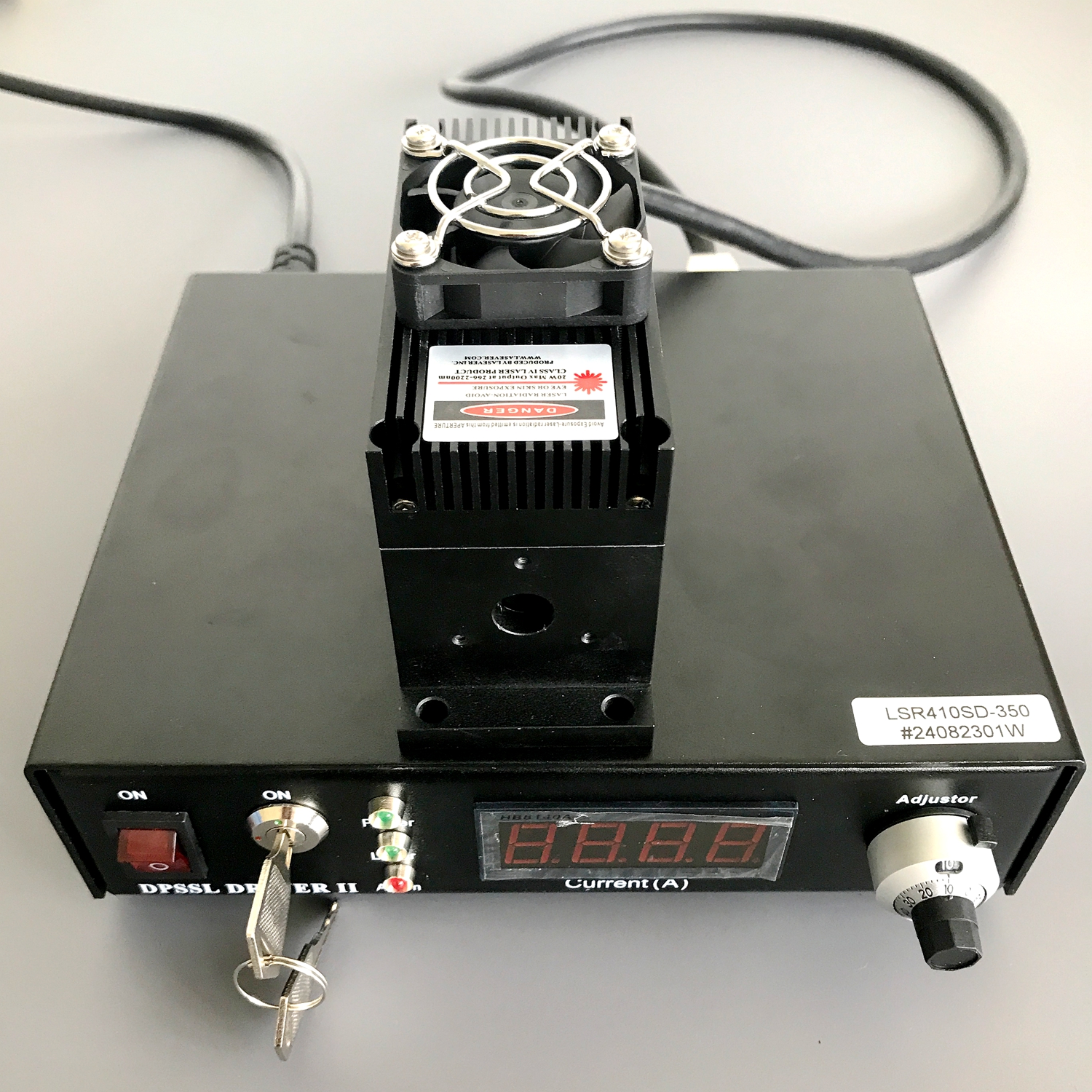

You can get some more information about 320nm DPSS Laser systems as following:
High-performance 320-nm continuous-wave solid-state laser
Other 320nm Lasers with differenct specs and datasheets
320nm CW Laser Single Longitudinal Mode,
Single longitudinal mode lasers are ideal for any application where narrow linewidth and or precise knowledge of the laser’s wavelength is needed since it is the only case in which there is only one fundamental frequency component to the laser’s spectrum.
| Model | Output Power (mW) | Power Stability (rms, 4 Hours ±3℃) | Spectral Linewidth (MHz) | Noise of Amplitude (RMS, 20Hz‑20MHz) |
|---|
| BQMSL‑FN‑320 | 1~30mW | <0.5% | <1 | <0.5% |
| BQUV‑FN‑320‑X | 1~50mW | <1% | <1 | <0.25% |
| BQUV‑FN‑320‑SLM | 50~100mW | <0.5% | <1 | <0.25% |
| BQMSL‑R‑320 | 100~1000mW | <1% | <5 | <0.5% |
320nm CW Laser Low Noise
A low-noise laser is a specialized light source designed to keep power, frequency, and beam direction extremely steady, reducing unwanted fluctuations or jitter.
| Model | Output Power (mW) | Power Stability (rms, 4 Hours ±3℃) | Spectral Linewidth (nm) | Noise of Amplitude (RMS, 20Hz‑20MHz) |
|---|
| BQUV‑FN‑320‑LN | 1~30mW | <1% | <0.003 | <1% |
| BQUV‑DP‑320‑LN | 30~1500mW | <0.5% | <0.003 | <1% |
320nm CW Laser High Stability
A high-stability laser is a specialized light source engineered to maintain an extremely consistent output—whether you care about stable optical power (amplitude), a fixed wavelength/frequency, or ultra-low timing jitter in pulsed systems.
| Model | Output Power (mW) | Power Stability (rms, 4 Hours ±3℃) | Spectral Linewidth (nm) | Features |
|---|
| BQUV‑FN‑320 | 1~200mW | <1% | <0.2 | TEM00 |
| BQUV‑DP‑320‑A | 200~500mW | <1% | <0.2 | Air Cooled |
| BQUV‑DP‑320‑B | 500~4000mW | <0.5% | <0.2 | Water cooled |
320nm Pulsed Laser Actively Q-switched
320nm lasers have both CW 320nm laser and pulsed 320nm laser . The main difference between actively and passively Q-switched lasers comes down to how they control the laser's internal loss (the Q-factor) to release high-energy, short pulses. Active systems use an externally triggered electronic or mechanical device, while passive systems rely on a self-acting optical material.
| Model | Single Pulse Energy | Average power (mW) | Repetition Rate | Pulse Width (ns) |
|---|
| BQAO‑U‑320‑DP | 1~8μJ | 1~40mW | 1‑30kHz | ~13@5kHz |